

Only Authorised, Liberated Gurus
Back To Prabhupada, Issue 73, Vol. 2, 2022, Interactive
Editor replies:
The first letter you are referring to is the one sent to Siddhasvarupa's follower Tusta Krsna, wherein Srila Prabhupada says:
"during the lifetime of your Spiritual master you bring the prospective disciples to him, and in his absence or disappearance you can accept disciples without any limitation. This is the law of disciplic succession."
(Srila Prabhupada Letter to Tusta Krsna, 2/12/75)
1) This letter simply states that a disciple initiating can only happen after Srila Prabhupada has physically departed. Srila Prabhupada is stating the time period in which such a thing may occur.
But, in order for this to happen, at least 2 conditions need to be satisfied:
a) Srila Prabhupada renounces his position as ISKCON's diksa guru.
b) There exist some qualified disciples, and Srila Prabhupada authorises these qualified disciples to take his position as ISKCON's diksa guru.
None of these things happened, and indeed the absence of a) alone precludes b) from happening.
2) Regarding the letter to Janardana you sent, here is what it states, with numbering added to the sentences for ease of reference:
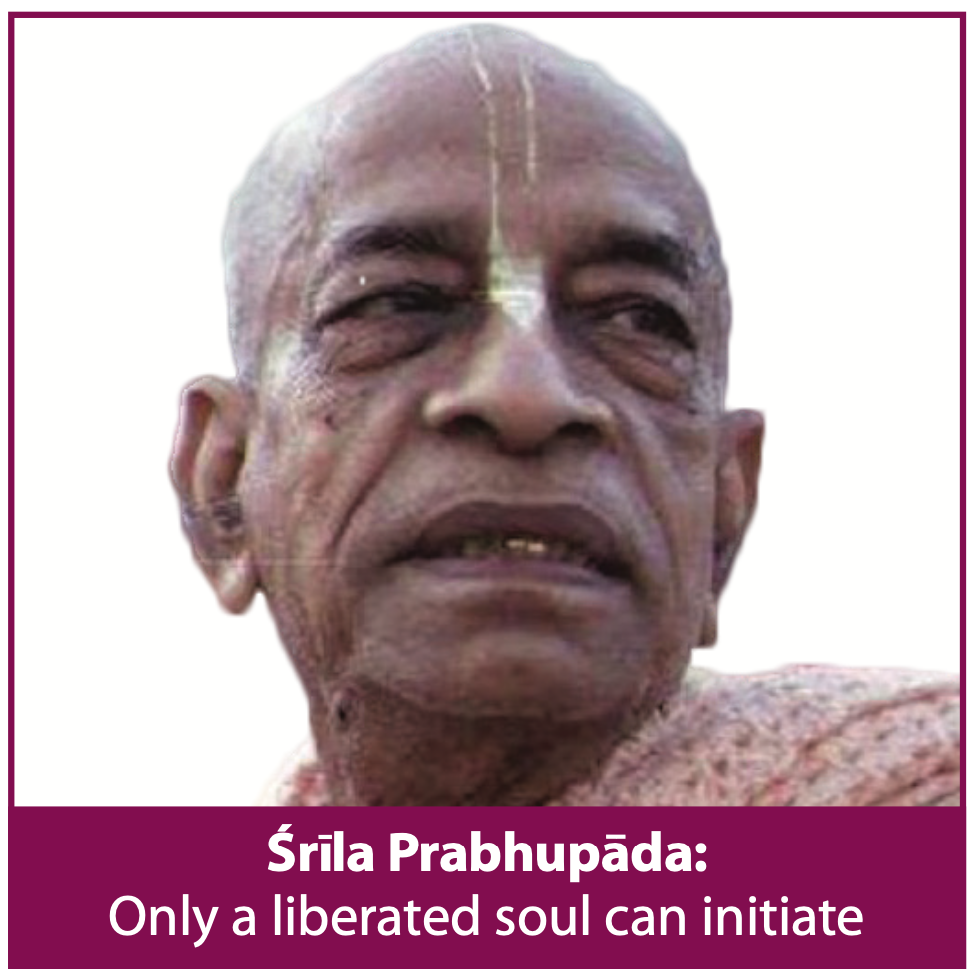
"On the whole, you may know that he is not a liberated person, and therefore, he cannot initiate any person to Krishna Consciousness. [1] [...] Generally the spiritual master comes from the group of such eternal associates of the Lord; but anyone who follows the principles of such ever liberated persons is as good as one in the above mentioned group. [2] [...] A person who is liberated acharya and guru cannot commit any mistake, but there are persons who are less qualified or not liberated, but still can act as guru and acharya by strictly following the disciplic succession. [3]"
a) Sentence 1 makes it clear that a non-liberated person cannot be a diksa guru.
b) Sentence 2 states that the diksa guru is generally a nitya-siddha, i.e. ever liberated, but others who are not nitya-siddha (sadhana-siddha) can also become qualified to be a spiritual master by following the principles of such ever liberated gurus.
c) Sentence 3 simply repeats what sentence 2 just said by stating that those who are not liberated, i.e. the sadhana-siddhas, can also become diksa gurus by strictly following the disciplic succession. Obviously, as a result of such strict following, they will become qualified to act as a diksa guru, i.e. liberated. This is confirmed by sentence 1 which states that only such a person can act as a diksa guru.
Subscribe for FREE to Back To Prabhupada Magazine - Click Here
Please chant: Hare Krishna, Hare Krishna, Krishna, Krishna, Hare, Hare,
Hare Rama, Hare Rama, Rama, Rama, Hare, Hare. And be Happy!