

Back To Prabhupada, Issue 37, Autumn 2012
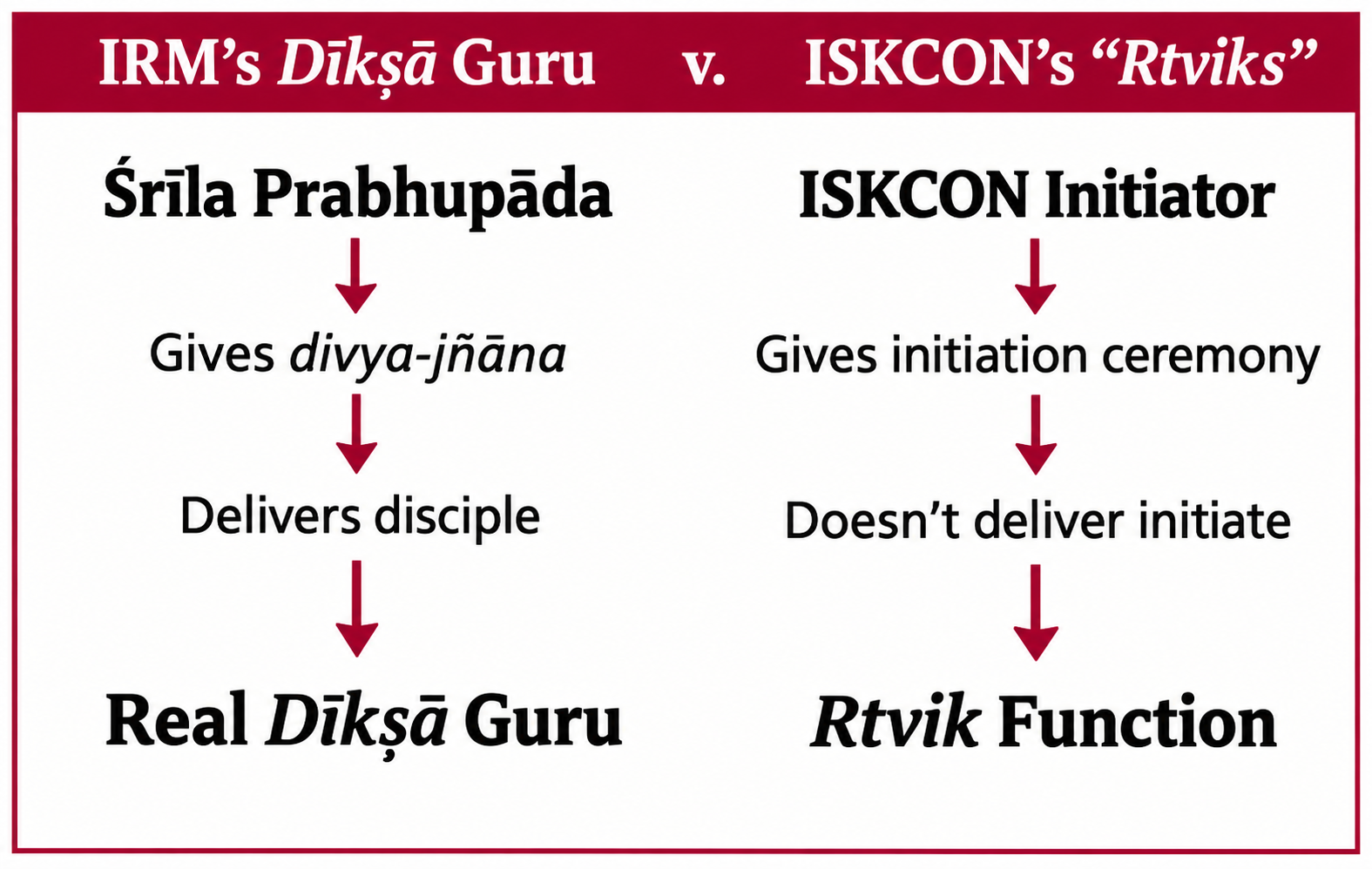
In the last issue we presented a diagram summarising the evidence from many previous BTP issues ("ISKCON's Rtvik System Summarised"). This diagram showed that ISKCON's supposed initiating gurus actually end up functioning at best as default ṛtviks (those who just conduct the initiation ceremony) who merely pretend to be dīkṣā gurus. In contrast, the system of accepting Śrīla Prabhupāda as the dīkṣā guru was the standard system of initiation in ISKCON before Śrīla Prabhupāda's physical departure, and all sides accept that it was bona fide. And the IRM simply proposes that this system continues. Under this system, many disciples never met Śrīla Prabhupāda either before, during or after initiation. The characteristics of such a dīkṣā guru system are detailed below.
The divya-jñāna dīkṣā guru
Accepting Śrīla Prabhupāda as one's dīkṣā guru is the acceptance of the personality who, through his spiritual teachings provides the transcendental knowledge, or divya-jñāna, which is dīkṣā:
"dīkṣā actually means initiating a disciple with transcendental knowledge by which he becomes freed from all material contamination."
(Śrī Caitanya-caritāmṛta, Madhya-līlā, 4:111)
"dīkṣā, dīkṣā. Di... Divya. There are two words, divya-jñāna. Divya-jñāna means transcendental, spiritual knowledge."
(Śrīla Prabhupāda Lecture, 22/2/1973)
Whereas, the GBC-elected ISKCON initiators, as explained on page 6 of this issue, admit to hardly providing any knowledge; directing their disciples instead to read Śrīla Prabhupāda's books.
The paramparā guru
Accepting Śrīla Prabhupāda as the dīkṣā guru means accepting the dīkṣā guru as directed by śāstra (scripture) - one who is in the paramparā (disciplic succession), does not fall down and always remains in the paramparā:
"A bona fide spiritual master is in the disciplic succession from time eternal, and he does not deviate at all from the instructions of the Supreme Lord".
(Bhagavad-gītā As It Is, 4:42)
The GBC-elected ISKCON initiators, however, frequently do fall down, and, as evidenced in last issue's diagram, do not even need to be in the paramparā.
The qualified guru
Accepting Śrīla Prabhupāda as the dīkṣā guru means accepting the dīkṣā guru as directed by śāstra - one who is on the topmost level of Kṛṣṇa consciousness:
"When one has attained the topmost position of mahā-bhāgavata, he is to be accepted as a guru and worshipped exactly like Hari, the Personality of Godhead. Only such a person is eligible to occupy the post of a guru."
(Śrī Caitanya-caritāmṛta, Madhya-līlā, 24:330)
The GBC-elected ISKCON initiators, meanwhile, have been declared to not be situated on this level by ISKCON's sannyāsa minister, who accepts that none are "completely aware of the Supersoul". ('Duties of GBC and Guru in ISKCON', 2006, & email: 30/8/2006, Prahlādānanda Swami)
The right guru
A consequence of the qualification standard just stated is that Śrīla Prabhupāda is always carrying the Lord within his heart, whereas the GBC-elected ISKCON initiators are not - which means that Śrīla Prabhupāda is the right person to be initiated by:
"Unless one is initiated by the right person, who always carries within his heart the Supreme Personality of Godhead, one cannot acquire the power to carry the Supreme Godhead within the core of one's own heart."
(Śrīmad-Bhāgavatam, 10:2:18)
The liberating dīkṣā guru
Accepting Śrīla Prabhupāda as the dīkṣā guru means accepting the dīkṣā guru as directed by śāstra - the personality who actually delivers the disciple. Whereas, in the last issue's summary diagram, we presented evidence showing how the GBC-elected ISKCON initiators themselves have admitted that it is Śrīla Prabhupāda, and not themselves, who delivers their "disciples":
"The spiritual master initiates the disciple to deliver him, and if the disciple executes the order of the spiritual master and does not offend other vaiṣṇavas, his path is clear."
(Śrī Caitanya-caritāmṛta, Madhya-līlā, 1:218)
The traditional dīkṣā guru
All of the above demonstrate that accepting Śrīla Prabhupāda as the dīkṣā guru is driven by the standard idea of who should be accepted as one's dīkṣā guru - a fact that even ISKCON acknowledges:
"the "zonal ācārya" system and the "posthumous ṛtvik" system - rest on adherence to the traditional idea of leadership."
(Allegiance to Guru, to ISKCON and to Prabhupāda, Ravindra-svarūpa Dāsa, 1998)
In contrast, ISKCON's current system, as documented in last issue's summary diagram, consists of de facto ṛtviks "pretending" to be dīkṣā gurus. This charade is not taught by Śrīla Prabhupāda or any scripture, and is therefore non-standard and a concoction.
Conclusion
The debate over the guru issue between the GBC and the IRM has been framed by the former as being one of "dīkṣā v. ṛtvik". Indeed, one ISKCON guru, Dānavīr Goswami, has even titled his paper, which specifically addresses the issue, as "Dīkṣā or ṛtvik" (answered here: www.iskconirm.com/dvs1.html). This paper claims that the GBC are advocating the system of dīkṣā guru in opposition to a ṛtvik system which "eliminates the dīkṣā guru". However, the facts presented above, together with the evidence from previous issues, leads to a startling conclusion that turns the debate between the IRM and the current GBC completely on its head. Thus, it is the GBC, and not the IRM, who are proposing a system of ṛtviks pretending to be dīkṣā gurus, instead of real dīkṣā gurus; and it is the IRM, and not the GBC, who are proposing a standard dīkṣā guru system, with a real dīkṣā guru! (See diagram above). Therefore, if the GBC want to prohibit "ṛtvikvāda" from ISKCON, they actually need to prohibit their de facto ṛtviks from masquerading as dīkṣā gurus and instead promote the real dīkṣā guru, Śrīla Prabhupāda! So devotees need to choose: